
Printing the future of EV battery packs.
ASPIRE is a Horizon Europe project on a mission to transform how battery packs are made — advancing large-scale additive manufacturing to make EV battery packs lighter, cheaper, and greener, while strengthening Europe's clean-tech value chain.
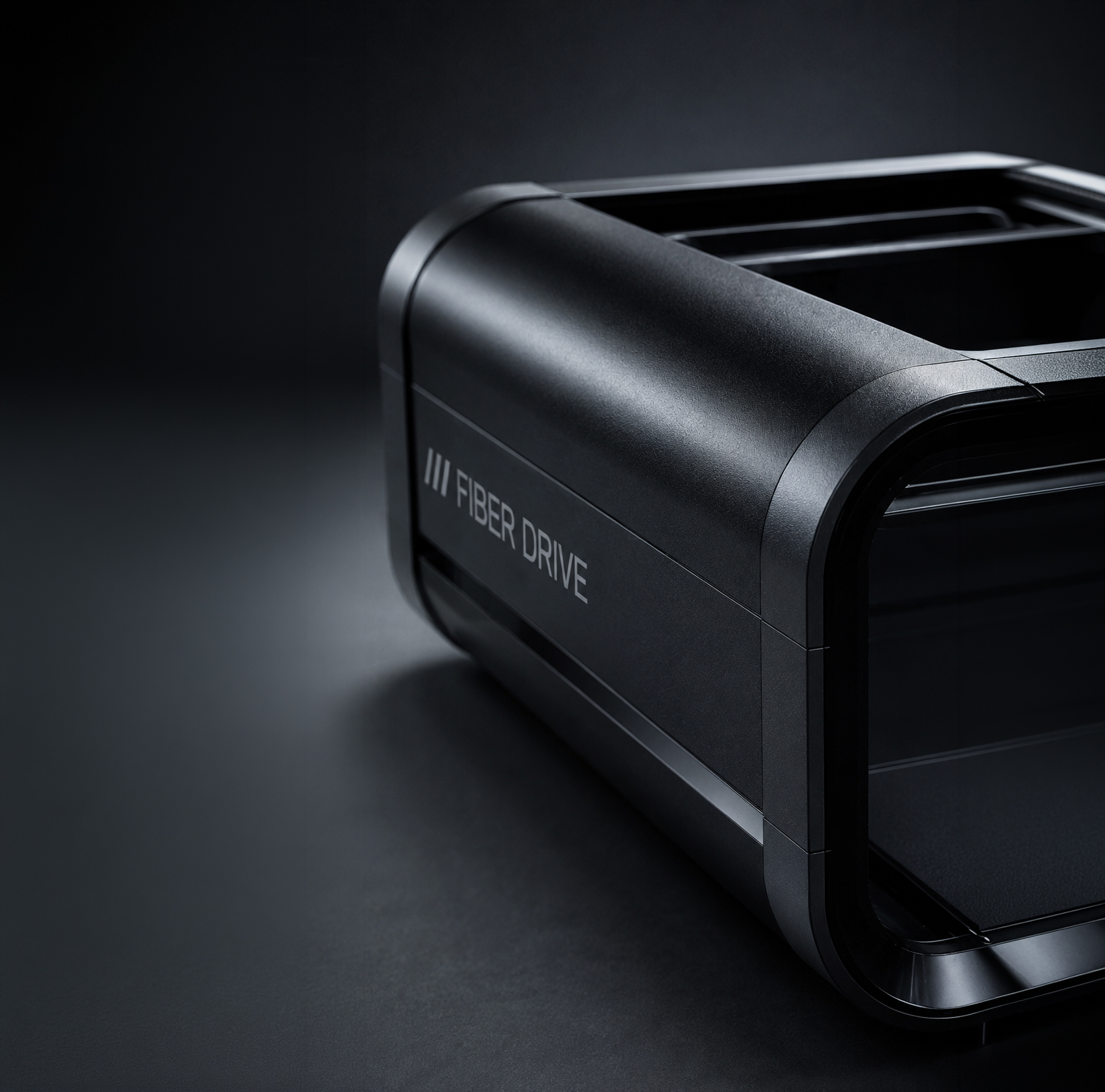
Built on partner AIRY's Fibre Drive technology, ASPIRE takes continuous-fibre thermoplastic battery packs to TRL 7 — validated at full scale, and ready for the road. The result: 50% less mass, 40% lower cost, and production that's right the first time, every time.
Powered by digital twins, predictive fibre-matrix modelling, and inline quality control, ASPIRE doesn't just build one battery pack — it builds a scalable, reconfigurable system that adapts across OEM platforms. Fewer parts. Simpler assembly. Built for disassembly, repair, and reuse — closing the loop on thermoplastic composites from day one.
Validated by Volvo (trucks) and Stellantis (light-duty vehicles), and backed by rigorous testing and life-cycle evidence, ASPIRE is charting a replicable path for Europe's Net-Zero manufacturing future.
The numbers behind the project
Three measurable outcomes that define whether ASPIRE succeeds — mass, cost and circularity.
- 011.33 billion kilograms
CO₂ saved at scale — lighter parts, lower footprint
- 0230 percent
Lower CAPEX — smarter manufacturing, leaner investment
- 03from 2 years to 3 months
Design-to-production, radically accelerated
2026
Kick-off and system requirements
The consortium aligns on pack architecture, materials and the performance targets that define the rest of the project.
2027
Material qualification and digital twin
Continuous-fibre thermoplastics are characterised and mirrored in a predictive digital twin of the printing process.
2028
Full-scale printing and integration
First monolithic battery-pack housings are printed at scale and integrated into a demonstrator vehicle platform.
2029
Validation and production roadmap
Structural, thermal and circularity validation feeds an industrial roadmap for European series production.
Why this matters, now.
Electric vehicles are essential to a cleaner automotive future — but today, they still can't fully compete with combustion vehicles on cost, range, or speed to market. Four critical barriers stand in the way:
- 01
Slow and rigid development
Wide battery pack design variation across manufacturers forces costly retooling for every new model, with most OEMs reinvesting every 5–8 years.
- 02
Current materials are holding EVs back
Current aluminium battery structures introduce real risks: weld porosity that can worsen thermal runaway, poor cold-weather performance, extra weight, and lower range and efficiency compared to combustion vehicles.
- 03
3D printing isn't precise enough — yet
Continuous-fibre 3D printing remains trial-and-error, with today's models struggling to capture the complex physics of fibre-thermoplastic flow.
- 04
Carbon EVs manufacturing bottleneck
Wasteful subtractive manufacturing processes and welded assemblies for EV production resist repair, disassembly, and reuse. With EV production set to top 30 million units by 2030, the industry can't keep manufacturing the old way.
Together, these barriers are more than technical hurdles — they're what's standing between Europe and a competitive, sustainable EV industry, in line with the Net-Zero Industry Act's call for cleaner, faster, and more resilient manufacturing.
The project goals / the solution
ASPIRE turns the four barriers holding EVs back into a single integrated manufacturing system — connecting problems, technology, and outcomes in one closed loop.
- LOWER CAPEX
- LIGHTWEIGHT HIGH-IMPACT STRUCTURES
- REDUCED CO₂e
By combining AIRY's FIBER DRIVE additive manufacturing technology with digital design and a reusable virtual library, ASPIRE tackles some of the industry's biggest challenges: high cost, complex production, limited flexibility, and heavy carbon impact.
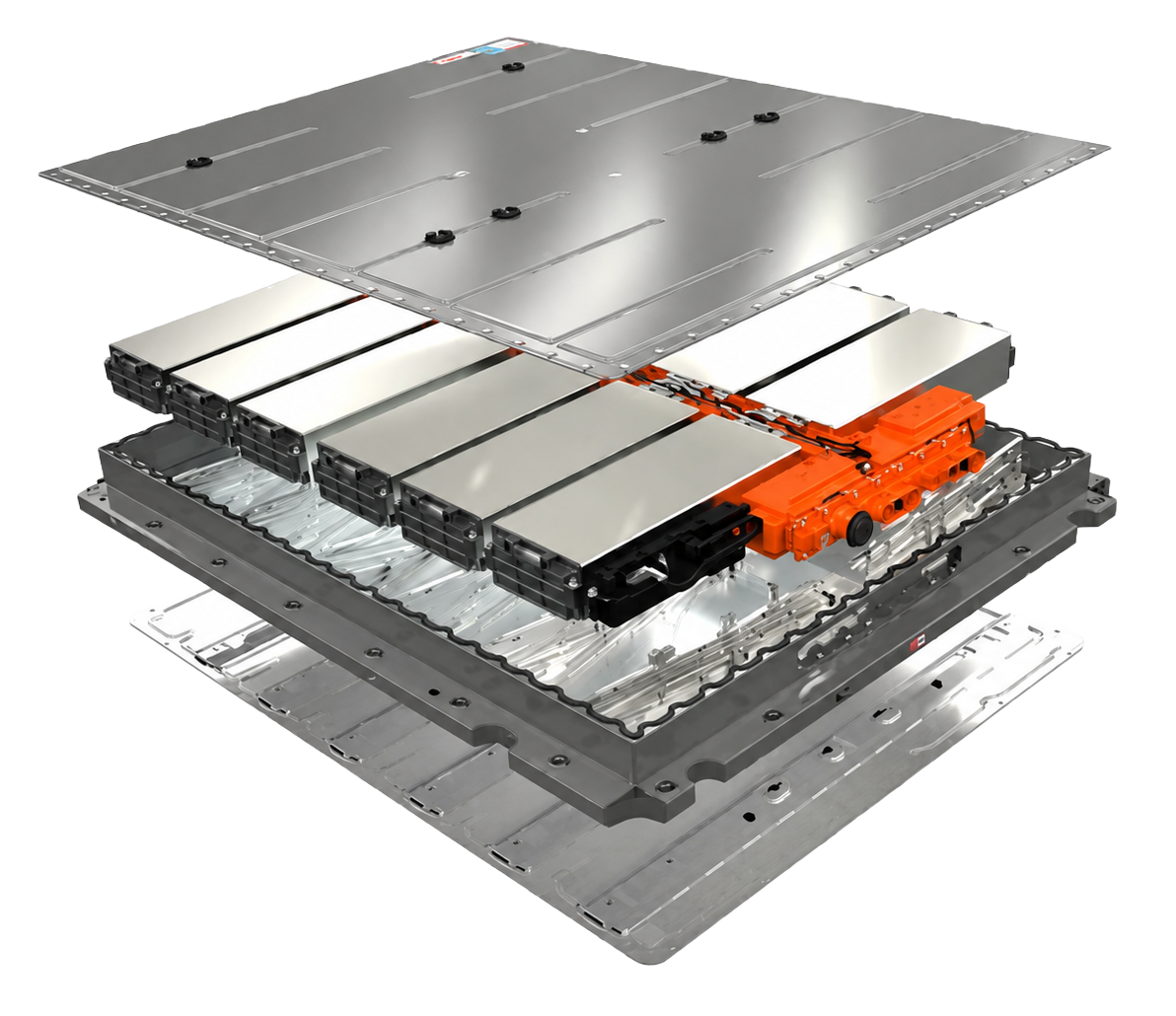
Tap a marker to see the component it identifies.
The result is an end-to-end, semi-automated manufacturing blueprint for battery packs that is validated, cost-backed, and ready to scale. It enables lighter high-impact structures, supports reuse and second-life composite materials, and can cut CAPEX by 50% in production and 20% in assembly. At full scale, the project aims to reduce emissions by over 1.3 billion kg CO₂e, helping accelerate the transition to cleaner, more competitive EV manufacturing.
The consortium aims to bring the project to life by reaching the following measurable objectives:
- 01
Advanced discrete manufacturing of lightweight, integrated Battery Pack Structures (BPS)
A full-scale BPS printed in continuous fibre thermoplastic composites at industrial build rates. The project will validate weight reductions of >50% compared to Al baselines while preserving crash and thermal performance, proven through OEM demonstrators.
- 02
Scalable and reconfigurable Battery Pack (BP) design enabled by additive manufacturing (AM)
FIBER DRIVE continuous-fibre AM technology deployed to print full-scale battery-pack housings directly from computer-aided engineering (CAE), eliminating most hard tooling. This will provide the first validation of cross-OEM reconfigurability, showing that scalable design can generate BPs for multiple vehicle types at reduced cost, footprint, and lead time.
- 03
Smart and predictable 3D composite prints
The first fully coupled 3D model of fibre-matrix deposition, linking stresses inside fibres with melt flow and wetting. The approach will also support programmable performance, allowing local tuning of mechanical, thermal and functional properties by design.
- 04
Use of digital twin enabling first-time right manufacturing
The first integrated digital twin for continuous-fibre AM, linking simulation, slicer, machine control and inline inspection. This integrated framework will close the loop between simulation and manufacturing, enabling first-time-right production and significantly reducing waste and development cycles.
- 05
Generating a library of scalable components with relevant standards
Create the first digital, parametric library of standardised battery pack components that embeds all current functional needs and allows for future structural, thermal and electrical requirements defined by the OEM demonstrators.
- 06
Design for the re-use, disassembly and recyclability of components and materials
BP design reduces structural part complexity by 60%, reducing time spent on assembly and disassembly. This design-for-disassembly approach will be validated through dismantling trials, proving increased repairability, extended lifetime, and improved recycling.
- 07
Valorisation of recycled polymers and fibres from end-of-life battery packs into new feedstocks
Transform recycled thermoplastic composites from dismantled battery packs into high-performance rods for 3D printing and long-fibre thermoplastic injection compounds. This circular system will reduce dependency on virgin materials, lower associated CO₂ and water use, and validate direct re-use of EoL pack materials in new housings.
- 08
Validation, testing, and compliance with standards + blueprint development
Validate the solution through testing from material to housing and system level, including crash, vibration, thermal runaway, sealing and durability testing.
Develop a validated blueprint for a semi-automated pilot line for large-scale components, optimising workflows, balancing manual and automated operations, and defining machine layouts for BPS production.
A collaborative, circular ecosystem.
Nine organisations across five countries share one value chain. Materials, manufacturing, battery-pack assembly, vehicles and end-of-life recovery are connected in a loop — not a line.
- 01 — MaterialsLofithRecycled feedstock · pellets · fibre filament
- 02 — ManufacturingAIRYFIBER DRIVE · printed battery pack structure
- 03 — AssemblyOPmobilityBattery pack assembly↩ Injection moulded parts — from Volvo · Stellantis
- 04 — OEMsVolvo · StellantisVehicle integration · vehicle lifecycle
- End of life — return loopDismantling → shredding → recycling → recycled pellets, fed straight back to Lofith.
- ↻ Back to materials
- 01AIRYAIRY Automotive ApSDenmark
- 02CEACommissariat à l'énergie atomique et aux énergies alternativesFrance
- 03OPmobilityOPmobility / e-Power FranceFrance
- 04LFT & UDTAPESLFT & UDTAPES Sociedad LimitadaSpain
- 05AVL ItaliaAVL Italia S.p.A.Italy
- 06NorthmooreNorthmoore ApSDenmark
- 07StellantisStellantis Auto SASFrance
- 08DTUDanmarks Tekniske UniversitetDenmark
- 09VolvoVolvo Technology ABSweden